How does PISÉO transform a laboratory setup into a reliable industrial system for non-destructive testing?
In the semiconductor and integrated photonics industries, the final performance of a component depends directly on the quality of the material used. When a crystalline defect is detected too late, after costly manufacturing steps, industrial losses become irrecoverable.
Identifying these defects early is therefore a major strategic challenge. However, this requires a measurement system capable of moving beyond experimental setups to become a reliable, repeatable, and industrially usable tool. This critical transition, from scientific proof to industrial equipment, is precisely where PISÉO brings its value.
The real challenge: transforming a scientific method into an industrial tool
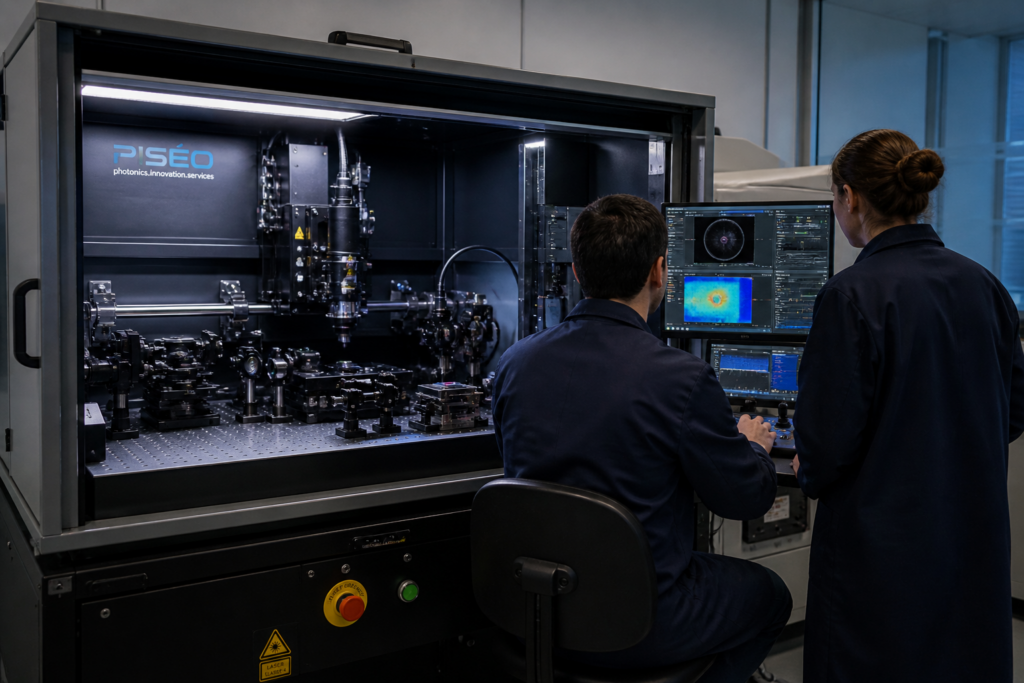
At the origin of the project, the characterization method existed as an experimental setup developed in a research laboratory. Its physical validity had been demonstrated, but industrial use remained impossible due to sensitive alignments, limited stability, expert handling requirements, and lack of operator reproducibility.
The challenge entrusted to PISÉO was not to replicate an existing setup, but to industrialize advanced photonic metrology.
The project was carried out in close collaboration with the client, NLOPTICS, involving an in-depth phase of scientific and technical understanding. This approach enabled not only the design of the optical bench, but also improvements to the measurement method itself to ensure robustness, repeatability, and industrial usability. This co-development capability is a key success factor in transitioning from laboratory to industry.
Securing the qualification of strategic photonic materials
The developed system enables non-destructive characterization of advanced materials used in integrated photonics, particularly lithium niobate (LiNbO₃), a key material for electro-optic and nonlinear devices.
The objective is clear: provide a tool capable of qualifying materials to secure industrial decision-making.
The system allows to:
- Map crystalline quality
- Detect dislocations and anisotropies
- Qualify substrates up to 300 mm
- Reduce technological and financial risks before industrialization
The optical bench thus becomes a true industrial decision-support tool, enabling rapid validation of material compliance before engaging in critical production steps.
A metrology based on nonlinear reflectometry
The solution relies on an advanced nonlinear reflectometry technique based on second harmonic generation (SHG).
The material is illuminated with an infrared femtosecond laser, while the optical response generated at twice the fundamental frequency is analyzed. The observed variations, combined with polarization state analysis, reveal signatures directly linked to the crystalline structure.
Unlike conventional optical approaches, this method detects structural defects that would otherwise remain invisible, while remaining fully non-destructive.
The key to performance: precision opto-mechanical architecture
While performance relies on beam physics, reproducibility depends primarily on opto-mechanical design.
Grazing incidence, micrometric focusing, and the detection of extremely weak signals require exceptional mechanical and thermal stability. The slightest displacement or drift compromises metrological validity.
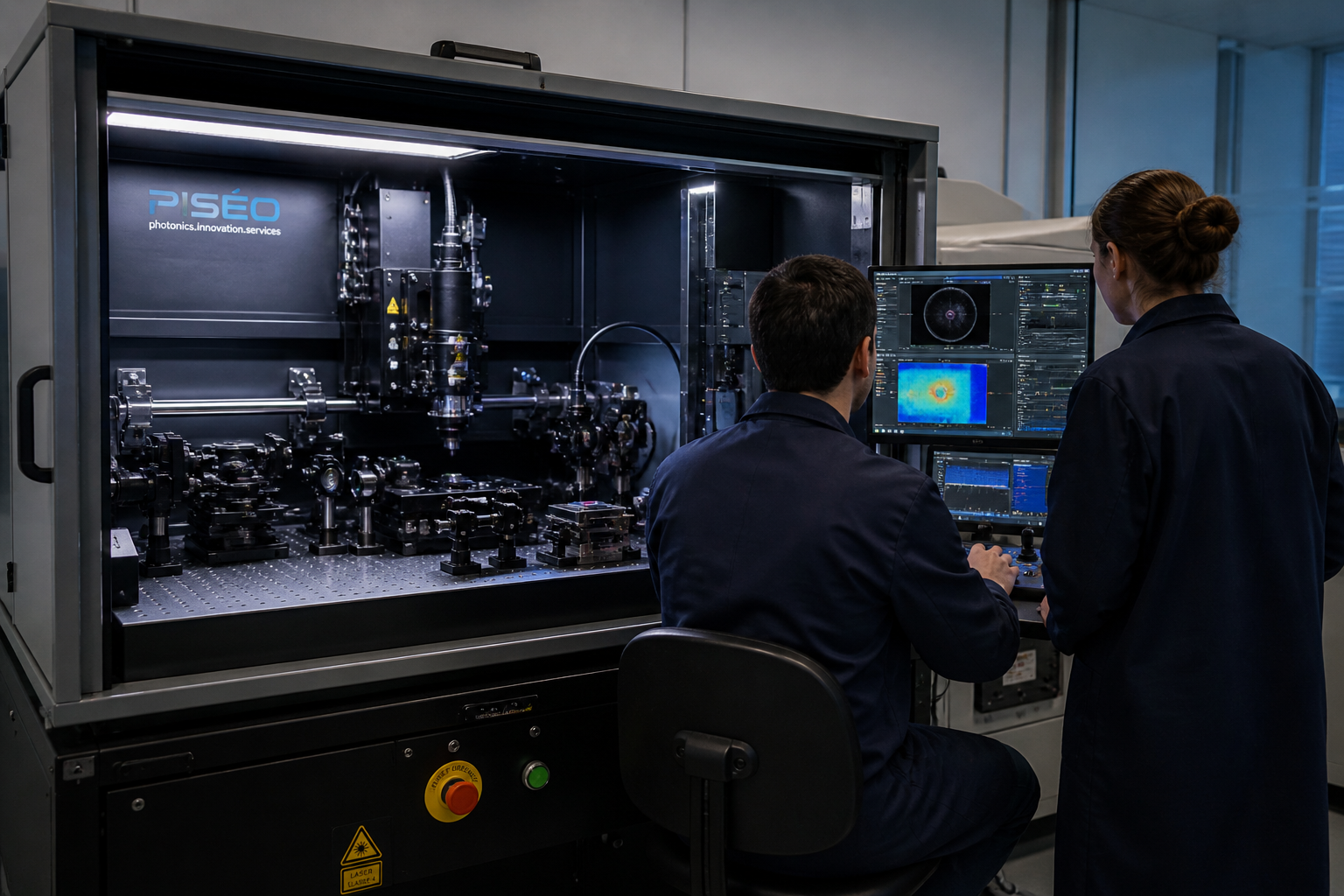
PISÉO designed a complete architecture integrating:
- A high-power femtosecond laser (~2 W)
- Beam shaping and micrometric focusing
- Custom opto-mechanical assemblies ensuring rigidity and long-term alignment
- Multi-axis motorized stages enabling sub-micrometric positioning
- A high-sensitivity detection chain based on a photomultiplier tube (PMT) with strict spectral filtering
The manufacturing of these subsystems relies on a network of precision machining partners, selected and managed by PISÉO. This full control over opto-mechanical design and associated automation is a decisive competitive advantage to ensure system stability during long measurement campaigns. Without this stability, reliable industrial operation is impossible.
System engineering designed for industrial use
The difference between an experimental setup and industrial equipment does not lie in the components themselves, but in the system engineering that connects them.
Each design decision was made at the system level to ensure:
- Operator safety
- Long-term reliability
- Maintainability
- Metrological repeatability
The integration of a Class 4 laser source illustrates this approach: energy density calculations, optical design, ultrashort pulse management, and the integration of control systems ensure safe operation in an industrial environment.
The system maintains its performance across mapping processes involving hundreds of measurement points over several hours, without alignment drift or signal degradation.
When engineering reduces industrial risk
Advanced photonics projects rarely fail due to scientific limitations.
They fail during industrialization.
A custom optical bench becomes far more than a measurement instrument: it is a strategic lever enabling:
- Upstream material qualification
- Reduction of process risks
- Securing substrate investments
- Acceleration of time-to-market
- Controlled transfer of innovation to production
PISÉO, partner for industrializing photonic technologies
Transforming scientific innovation into sustainable industrial advantage requires far more than optical expertise. It demands a combined mastery of optics, precision mechanics, and system engineering.
This is precisely the role PISÉO plays for its industrial partners: designing, securing, and industrializing complex optical systems capable of operating reliably in demanding environments.
Choosing PISÉO means relying on a partner capable of transforming laboratory technologies into robust, operational, and durable industrial equipment.